• Welcome to the BMW R18 Forums. Member registration disables ads and allows you to post and share. Register Here.

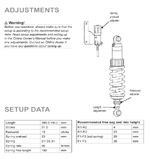
Wilbers Shock on base model.

  • <i class="fa--xf fal fa-check "><svg xmlns="http://www.w3.org/2000/svg" role="img" aria-hidden="true" ><use href="/data/local/icons/light.svg?v=1758297946#check"></use></svg></i> Discussion starter Discussion starter Folo
  • Start date Start date
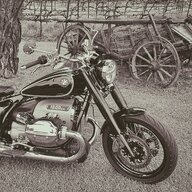
Picture with Wilbers +20mm installed. Headed out for my first decent ride (120klms) on the weekend and it was a
200% improvement Vs the demo I rode a few months ago. Along the same country road with bumps and dips. It drops about 15mm when hop on.
Fwiw.... mine (+20mm) was delivered with a bit much preload.... almost no static sag.... I ended up backing off preload to get 8mm static sag and just under 30mm rider in gear sag.

I assume the bike you test road may have not had the rear preload set?
 
Fwiw.... mine (+20mm) was delivered with a bit much preload.... almost no static sag.... I ended up backing off preload to get 8mm static sag and just under 30mm rider in gear sag.

I assume the bike you test road may have not had the rear preload set?
Correct, the preload was not set so I adjusted it myself (ex mechanic). It did improve the ride a lot. I later heard about Wilbers, and it has taken compliance and rebound to another level.
That together with the Option 719 seat, and I’m a happy rider.
 
I finalised the "Wilbers" set up of my R18 today.... did a 200km fastish ride on my local roads (mostly hills) and am now satisfied with it. I have the +20 rear shock, wilbers fork springs, 7.5w fork oil and YSS emulators installed in the forks.

I rode the same route last week on my other bike to re-familurise myselfy with a base line of suspension performance so I did not aproach todays R18 ride with unrealistic expectations.

Anyway..... points of note (83kg rider in gear)

1. All the good points of stock suspension (stable, turns well etc) still....
2. Less harsh on poorer surfaced roads, less bottoming out.
3. Less peg scraping..... really almost none... none today.

I ended up setting less rear spring preload then how it was shipped.... so 25mm (for 7mm static sag and about 30mm rider sag) not 31mm.... but dampening was set about right.... (I had played with dampening a bit before revisiting preload).

The forks are a bit softer now ..... but I haven't measured sag because I'm a bit lazy and the fork shrouds make it difficult. No reason to bother playing with other oil viscosities or adjusting the YSS emulator as rebound and compression dampening (fast and slow) seem ok. I have ridden over lots of speed humps and fast railway crossings.... and all is better than stock....

Some of my earlier frustration was probally caused by the change of seat to a "Homage" one at the sametime..... in my view the Homage seat brings a degree of harshness via ones butt.... (for a more favourable hip angle etc).....anyway.... replacing the metal seat risers (that I added to raise the seat an inch or so) with urethane ones with some give in them has taken the edge off this aspect of the seat.... especially with sharp high speed road irregularities (say 50-60mph... tree roots pushing up road surface.... quite common on Adelaide Hills back roads).

I'm not overly sure if the YSS emulators are a real benefit.... they are on my R nine t scrambler.... I really notice the difference on unsealed roads when I hit unavoidable pot holes.... like after rain etc.... a world of difference on that bike (they bring proper high speed compression dampening adjustability).... but.... I don't ride those roads on the R18.... I think most of the R18 fork benefit I'm feeling is the new springs and slightly lighter (as wilbers recomend) fork oil.... but.... the emulators are only $150 in the scheme of things..... and I don't have to slow as much for shoping centre speed humps now....
 
Last edited:
Can you use the stock preload adjuster hex head on the Wilber? I like the location for access as it’s tucked away but easily accessible
 
Last edited:
Can you use the stock preload adjuster hex head on the Wilber? I like the location for access as it’s tucked away but easily accessible
I got told no.

Also... if paying additional for their preload adjuster (as opposed to the standard manual rings)... the shock comes with a shorter spring... the supplier in Australia could not tell me if that reduced shock travel from their 100mm and 115mm (+20mm).... keep in mind stock travel is 90mm (in my view there would be some trade off... but who knows... haha... wilbers off course!). I would look up the contact page (on the HQ site in Germany) and ask them... they responded to my questions around travel.... I don't think some of the country distributors know much.

With the stock collars... one does need to remove the seat to use the tool that comes with the shock.... but... one can adjust it via the RHS side cover.... with a screw driver and a hammer... a bit rough for some I'm sure.
 
Last edited:
I got told no... if paying additional for their preload adjuster (as opposed to the standard manual rings)... the shock comes with a shorter spring...

With the stock collars... one does need to remove the seat to use the tool that comes with the shock.... but... one can adjust it via the RHS side cover.... with a screw driver and a hammer... a bit rough for some I'm sure.
Ugh, this seems irritating as a solution, especially if you’re desiring the extra +20 increase in clearance. If the R&D is going into the product, I’d expect a solution to adjust them to be also considered and easy to do. I love Ohlins for that reason among serviceability.
 
Ugh, this seems irritating as a solution, especially if you’re desiring the extra +20 increase in clearance. If the R&D is going into the product, I’d expect a solution to adjust them to be also considered and easy to do. I love Ohlins for that reason among serviceability.
I think you are reading something into my reply that I didn't intend......
 
Pretty sure they have an optional mechanical adjuster that uses existing hex. It’s an extra 300 ish
 
There’s a few places I could post but seeing as this thread is active and related to what I want to write I’ll go here…..my bike is stock BTW.

I’ve had my R18 a year now, really happy with it. I’m 115kg or 253lbs so not a light rider. I prefer bigger and heavier bikes because they feel more comfortable under me, I don’t overwhelm them if you know what I mean. Anyway, to the point.

After a few weeks of ownership (and reading up on this forum) I initially set my rear shock on 6 turns clockwise, from fully backed off (bearing mind by fully backed off I mean where you just start to feel resistance turning clockwise). This made a difference and I was quite happy with that so left it there. Until today. Don’t know what made me think of it but I was curious so added a couple more turns clockwise (making 8 altogether) before I went out for a short ride and what surprised me was how I could really notice a positive difference. I promise you this is not some placebo thing either. Riding on exactly the same roads at the same speeds I always do the bike was way more plush at the rear, especially going over sharp ridges in the road where it would previously jar a bit.

I fully appreciate comfort is subjective and why owners go down the aftermarket shock route but honestly, if you haven’t experimented with your rear preload I would absolutely encourage you to try. As long as you record where you start from you can always return it if it doesn’t work out.

After returning from my ride I was delighted with it. So much so that as soon as the kettle went on I knew I was going to share on here. I may even try a bit more preload yet, don’t know but I hope this may be of use to some of you and save a bundle of cash too.
 
Just an update. I've now replaced the front coils with Wilbers zero friction progressive fork springs. To be honest I didn't notice an immediate improvement like the Wilbers rear shock until I rode across undulations, and on back roads the fronts made the riding experience a whole lot easier, especially vibration wise. A significant improvement on long rides and I was less fatigued after a day of riding.

https://www.wilbers.de/shop/en/Moto...ring-Zero-friction-progressive.html?year=2023
 
Last edited:
Just an update. I've now replaced the front coils with Wilbers zero friction progressive fork springs. To be honest I didn't notice an immediate improvement like the Wilbers rear shock until I rode across undulations, and on back roads the fronts made the riding experience a whole lot easier, especially vibration wise. A significant improvement on long rides and I was less fatigued after a day of riding.

https://www.wilbers.de/shop/en/Moto...ring-Zero-friction-progressive.html?year=2023
On the Wilbers site the notes state 120mm air chamber is recommended. What are they referring to?
And much fork oil was required to do the spring swap?
 
Last edited:
I have the Wilbers rear shock with +20 and height adjuster (height is at maximum just below the marked dot on the threads) and I am having trouble with preload. I have the XPA model. The static sag can reach maximum 5-6 mm when the dynamic sag is >40 mm. When the dynamic sag is 29-30 mm, the static sag is only 2-3 mm.

Should I be worried about the static sag?

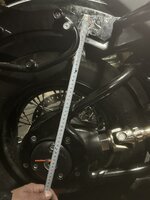
For reference, I am about 110 kg with full riding gear. The measurements I made was not vertical from rear axle to a point on fender, I used a point on the fender drawing an arc from the center of the circle (swing arm pivot point to rear axle). I am attaching a photo for reference. I have front and rear crash bars and rear rack + pillion backrest from Roadstyler (not sure if this makes too much difference

Because of the still limited rear shock travel, I assumed that the dynamic sag was more important and that it should be around 30 mm. So right now, I am using it with 2-3 mm static sag and 29-30 mm dynamic sag. Am I wrong to think this way? Should I be worried about static sag? I also asked the same question to Wilbers but I trust the knowledgeable people in this forum more.
 

Attachments

  • IMG_4330.jpeg
    IMG_4330.jpeg
    1.5 MB · Views: 20
Last edited:
I’ll say this with the caveat that I am not completely following you.

Sag should be about 20% of the total shock travel. There are many ways to measure this. Many involve the geometry of the bike. I always opt for simplicity.

Find out how far the shock actually compresses. Forget about bike travel.

Put a zip tie on the shock shaft

Carefully sit on the bike with full weight. (the zip tie will move under compression and remain there when you get off.).

Measure that distance. It should be roughly 20-25 % of the total

Hope that helps. If not I apologize.
 
I'd not sweat static sag on a bike like this... rider sag would rule. Normally measured in the verticle.

Anyway, I'd ride it over some of my normal challenging roads and make one adjustmet at a time... rinse and repeat and form a view from there.

Fwiw.... rear wheel travel is not the same as shock stroke length...

Also what weight did you quote when ordering?.... luggage?... pillion?
 
Last edited:
The weight when I ordered was for 2 up (me + wife with full gear around 180 kg). For this setup I need to increase the preload even more. For 2 up, should I aim for the same dynamic sag? (around 30 mm?)
 
To answer my own question…. It is not possible to set a similiar sag with 2 up. At least with my product or with the weight I put on (~180 kg).

Here are my 2 cents about the product and my current experience with it:

Wilbers advised me to set dynamic sag to 32 mm for single ride. I made a much more precise measurement method today with cameras and set the dynamic sag to 32 mm. Note that I used a front wheel chock so I still don’t rule out the possibility that this could give false readings. Anyway here are my results:

Static Sag: 5 mm
Dynamic Sag: 32 mm

Measuring it vertically made only 1-2 mm difference…

Then I measured the dynamic sag with my wife. It sagged further 25 mm making it 57 mm. Then I started increasing the preload only to find out after 16 full turns I reached the limit. This would only make 1 mm difference anyway, so I backed it off to where I was before and decided to use it with this setting for both single ride and riding with a pillion. So right now, if the total spring travel is 115 mm, I have only 59 mm left when 2 up even at max preload. I didn’t measure the stock shock so I don’t know if sags less at max preload and neither do I know if this sag for 2 up is acceptable. If the stock shock is able to achieve %30 sag with 2 up, then with Wilbers I have even less available remaining suspension, although very slight…

My assumption about the whole situation is (and I may be completely wrong here), this product’s preload isn’t to be messed constantly, changing it from single ride setting to 2 up setting. Probably this is why they ask you when you order the product about your weight and how often you ride the bike alone and with a pillion, luggage etc… and they set it up and send the product to you. I told them 70% of the bike I ride with my wife at the back, so they set the product for 180 kg close to full preload and with a softer than stock spring this maybe yields much better results than factory shock?

When I first bought the product, the XPA broke and they changed the XPA under warranty by the way. Eventhough they claimed the adjuster was forced passed its limit, they still honored the warranty. I was careful and I didn’t think I broke it, but now I think they might be right and that if it was very close to max preload, being not used to how much force applied was “normal”, I might have caused it.

Anyway, this is my current situation now. Do you think that this sag is normal for riding with a pillion and I should just ride it?
 
25 mm rear dynamic sag for 95 mm spring is around 26%. Wilbers suggests similiar (28%) for their 115 mm spring. Can these shocks maintain the same dynamic sag at max preload with riding with a pillion though? That is what I would like to know at the moment. If they are supposed to maintain it, then I am either a dissatisfied customer or I have a faulty product installed.

I know that in my KTM 1290 Super Adventure there is even less sag with a pillion at max preload, but of course it is a different type bike with a much longer and better shock. What about cruisers?
 
To be clear.... are you saying that when your wife gets on the bike.... the rear compresses a further 25mm.... (with shock set for you only on the bike)..... then you wind the preload all the way up.... which is 16x360degree rotations of the preload.... and the bike only rises 1mm?

If so I'b be a bit sus.

Anyway.... how does it ride? I assume you add a bit more dampening as well when 2 up.

I would always adjust preload when going from 1 up to 2 up.
 
Last edited:
To be clear.... are you saying that when your wife gets on the bike.... the rear compresses a further 25mm.... (with shock set for you only on the bike)..... then you wind the preload all the way up.... which is 16x360degree rotations of the preload.... and the bike only rises 1mm?.
In the manual it states that 16 clockwise turns increase the preload by 1mm, so there seems to be no issue there. It also states that from minimum preload to maximum preload, one can only adjust the preload by a total of 15 mm. (According to product manual, the XPA has 16 x 15 = 240 full turn capacity.)

My preload adjuster seems to change the preload as described in the manual.

The issue seems to be that the spring itself is too soft. If I turn the preload all the way counter clockwise to its minimum preload setting, it would 46 mm dynamic sag just for me (110 kg with riding gear). To set the dynamic setting just for me, to 32 mm, I need to increase the preload almost to the maximum setting (remember, it has 15 mm adjustability in total). And when a pillion of 70 kg sits on the bike, the sag drops further down 25 mm.

I don’t know if all Wilbers shock springs for R18 are this soft, but if they are and a pillion of 70 kg drops their sag down further by 25 mm, then everyone would have the same situation since the maximum adjustability of the preload is 15 mm.

For a spring of this softness, if they intended a preload setting that isn’t frequently adjusted between one-up and two-up riding, then probably a preload setting close to maximum is spot on…. One setting based on what I informed them when I placed the order… The XPA adjusting nut seems to be weak as well, and easy to strip. So maybe this product is a “set it and leave it” type of product.

Or…. My spring is too soft and different / faulty than what it should be for their products for this bike.

As I stated, I make the measurements on a front wheel chock. This raises the front wheel a bit from level, so maybe it transfers all the load to the rear, more than what it would during normal riding? I don’t have the knowledge or experience to know the effect of this. Measuring the dynamic sag for two-up riding without a front wheel chock is too hard for me.

By the way. İt seems to ride well. The feeling when I enter a pot hole is much better, and the cornering has improved. A softer spring “feels” much better. It is just this two-up dynamic sag that is a question mark in my head.

 
Last edited:
Back
Top