• Welcome to the BMW R18 Forums. Member registration disables ads and allows you to post and share. Register Here.

Just shoot me now…type of gas to buy

  • <i class="fa--xf fal fa-check "><svg xmlns="http://www.w3.org/2000/svg" role="img" aria-hidden="true" ><use href="/data/local/icons/light.svg?v=1789222567#check"></use></svg></i> Discussion starter Discussion starter motoring
  • Start date Start date

motoring

Active member
Joined
Jun 22, 2022
Messages
685
Visit site
Bike
05 r1200rt
So, I can get 93 unleaded as well as 89 ethanol free. Was going to buy 2 gallons of each, but the bike wouldn’t hold that much so I got 2 gallons of 93 and 1 gallon of ethanol free today.

Honestly I don’t know if I should just get the highest octane unleaded possible and not worry about ethanol, free, even though sometimes I may not ride the bike for a couple of weeks. Or, if I should do a half-and-half or mostly do ethanol free if I don’t write it for three weeks or a month at a time.

It’s hot down here in Florida. My old age and old body does not like riding in like 89° heat plus humidity which is like 93 feel like temps. Else do most of my riding no the R18 from 7am and stop at 10am else ride after 7pm for the rest of this long beep summer down my way.

Yes I know, cover up and do one of those water vest to help out if needed. Though between that plus air mess jacket plus my airbag vest makes for a warm beep riding setup.
 
Over the pond here we get 95 unleaded (E10) and 97 unleaded (E5) I get marginally better mileage on E5. I would stick with the 93 unleaded.
 
Yup, same here. I alway stick to the highest quality petrol or diesel I can get. I also steer clear of E10 unless there is really no other choice around and I am running low on fuel.

Worth having a bottle of Sta-Bil 360 Marine in the garage. Works wonders on E10 or similar or when storing fuel over a long period of time (winter storage- lawnmower/another bike /classic car etc)
 
BMW knows that ethanol-added fuel exists, therefore IMHO, I don't see any reason why normal 93 ethanol-added pump gas wouldn't be just fine.

However, if you are SUPER-a*al about ethanol in your fuel, you can remove the ethanol at home with a large gas tank with a petcock at the bottom, water, and food dye. Food dye is optional if your gas tank is clear, as it otherwise lets you clearly distinguish between gas/water in a semi-clear container.

Fill up the ethanol-added fuel to the gas tank, then add around 1 cup of water to 1 gallon of gas. Agitate/shake the container so the fuel/water mixes, then let it sit for at least 12 hours for thorough ethanol removal.

After 12 hours, the ethanol-free gas will sit on top of the water, which will be at the bottom of the container. Fuel/water don't like to mix. The ethanol molecules will bind to the water, as ethanol is hygroscopic. Use the petcock to drain out the water, leaving only the fuel behind.

Now, you have 100% ethanol-free gasoline. If you are willing to buy the initial equipment and spend some time/effort, you can avoid the jacked-up ethanol-free prices at the pump.

Mike
 
BMW knows that ethanol-added fuel exists, therefore IMHO, I don't see any reason why normal 93 ethanol-added pump gas wouldn't be just fine.

However, if you are SUPER-a*al about ethanol in your fuel, you can remove the ethanol at home with a large gas tank with a petcock at the bottom, water, and food dye. Food dye is optional if your gas tank is clear, as it otherwise lets you clearly distinguish between gas/water in a semi-clear container.

Fill up the ethanol-added fuel to the gas tank, then add around 1 cup of water to 1 gallon of gas. Agitate/shake the container so the fuel/water mixes, then let it sit for at least 12 hours for thorough ethanol removal.

After 12 hours, the ethanol-free gas will sit on top of the water, which will be at the bottom of the container. Fuel/water don't like to mix. The ethanol molecules will bind to the water, as ethanol is hygroscopic. Use the petcock to drain out the water, leaving only the fuel behind.

Now, you have 100% ethanol-free gasoline. If you are willing to buy the initial equipment and spend some time/effort, you can avoid the jacked-up ethanol-free prices at the pump.

Mike

It will also reduce the octane by a few single digits, so an octane booster is recommended. Once set up it's not much trouble to do. I confess to trying it on a small scale for chainsaws, but I really couldn't be bothered (I was only doing it in 2 ltr soda pop bottles).
 
Doing even the most basic math; I expect given your annual mileage, you will spill more at Starbucks to make up the cost difference.

Post less, ride more. Lol. All in good fun.
 
I wouldn't overthink it and certainly not to the point of mixing a gallon of this and a gallon of that trying to make a magic elixir blend.

Fresh petrol is better than old product so I try to buy from a station with steady customers/regular product replenishment. Octane manages combustion so as long as you aren't having engine pinging the grade of petrol being used is sufficient to safely operate the engine. That said, I try to run what the OEM engineers recommend.

If I had no choice other than "regular" grade petrol I would certainly buy it rather risk weaning the big girl and then just add a gallon or so to get me to the next area where a better option may be available for a complete fill up.

I've run "all options" on my local and cross country rides and the R18 handles them all very well. I prefer high(er) octane non-ethanol that is readily available near my home, but have also had no other choice other than to run tankfulls of crap blends in parts of the country that mostly caused very poor M.P.G. as the notable side effect.

With you being in Florida, I imagine many stations carry non-ethanol for the boat owners and if possible they would be my first choice (mid or premium octane IMO) and after that any mainstream station. Gas stabilizer products are helpful as @Anibal mentioned above, but if you are only waiting a few weeks between riding I wouldn't waste the money and effort as you are not going to see worrisome deterioration in that short a time period. I do use it when storing over winter months with great results.

Hot and humid in the South sucks the joy of riding out of me too. Big +1, Breakfast rides are my favorites year round, but especially in Summer.

Cheers
 
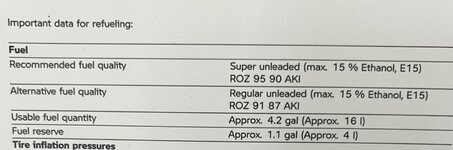
So maybe should the added some background info. Saw a video on the old K series bikes. They spoke about ethanol jelling up in bike tanks. Thinking, fuel injected bikes might not have that issue, as they have enough 'pressure' to break up the jelly and push it into the pistons. I did see this on the back of my R18 manual. I might have access to 91 ethanol free gas...will need to check a few stations.
Though if the rule is to buy highest grade possible then it would be 93 with maybe 10 to 15% ethanol. If that is fine for the R18 then that works for me.

My eyes 'jell' over when I see words like ROZ and AKI...sadly.

Thanks all
 

Attachments

  • IMG_2100.jpeg
    IMG_2100.jpeg
    670 KB · Views: 5
You are still way overthinking this. Octane for "regular, mid-grade and premium" will be different numbers in different regions due primarily to the effects of altitude in the fuel-air ratio. The amount of octane needed to control combustion (more octane than needed is a waste), it is an additive that helps prevent pre ignition detonation/rate of burn and too much is not beneficial (so no 1XX octane petrol from the airport :eek:) .

The good news is very smart people have done the math and formulated the petrol for local conditions so we don't have to worry if "regular is 86 or 87 octane or premium is 90,91,93", or whatever as our engines will be just fine even if we are changing elevations on the same tank of petrol.

Buy petrol, ride until more petrol is needed, repeat often 🍺🍺
 
Buy petrol, ride until more petrol is needed, repeat often 🍺🍺
Hell ya!!!

... and I give you another one to think of ... first of, I do use what goes around here for 'Premium' at the pump ... but how much 'Premium' am I actually getting? most people put 'Regular' in their cars and there is only 1 hose on the pump ... so whatever is in the hose is 'regular' and then comes the premium ... considering I am in the 3 to 3.5 Gallon range when I fill up ('21 FE) I am probably getting 1/3 of 'Regular' even though I am paying for 'Premium' ... ;)
 
I run 90 octane pure gas in my 2018 GSA and it starts up with one crank of the motor, even when it's below 40 degrees. It idles better, and the mpg is better than when I run 93 ethanol.
 
Back
Top